
by Andrew Rice
Wednesday, Lawmakers introduced a bill to require greater transparency on the national debt and GDP.
Reps. Lloyd Smucker (R-PA-11) and Jared Golden (D-ME-02) introduced the Debt-to-GDP Transparency and Stabilization Act. The legislation would require the president to submit reports in his annual budget requests that detail the effects of his budget on the country’s national debt and GDP.
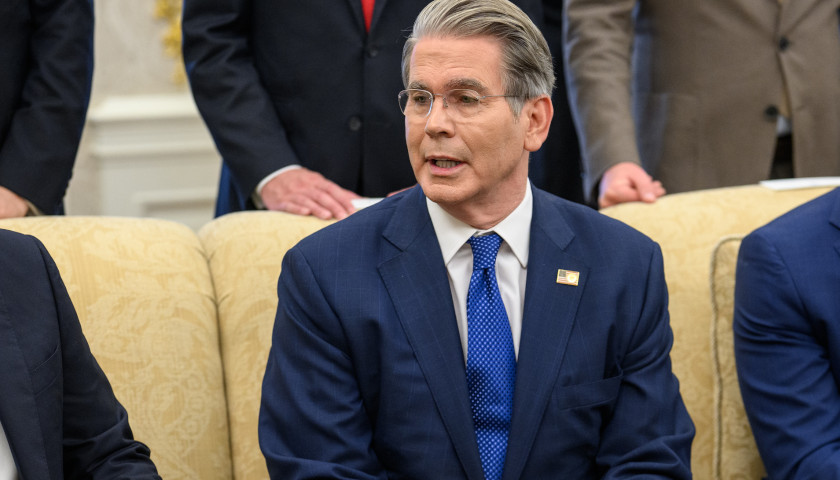
“Our national debt is the greatest threat to our country,” said Rep. Smucker (pictured above, right). “I’m hopeful this legislation will help correct our fiscal trajectory and ensure our nation’s long-term economic prosperity.”
The legislation would also require congressional budget resolutions to report the effect of policies on the national debt and GDP.
The United States’ national debt currently stands at approximately $38.9 trillion as of press time, and rising rapidly. This quates to roughly 136% of the nation’s GDP based on recent estimates – well above historical peacetime levels.
According to the Congressional Budget Office’s latest projections, debt held by the public is on track to reach 120% of GDP by 2036 under current policies, with longer-term outlooks showing the financial obligation surging to around 175% of GDP by 2056.
Beyond the fiscal burden itself, elevated and rising debt levels carry significant implications for the value of the U.S. dollar. Persistent deficits and growing borrowing needs can erode investor confidence in the nation’s fiscal sustainability over time, potentially pressuring the dollar’s status as the world’s dominant reserve currency. For Americans, the loss of that status would result in higher long-term interest rates for U.S. Treasuries, additional upward pressure on inflation, and a gradual depreciation if global demand for dollar-denominated assets weakens.
The U.S. House Committee on the Budget passed similar legislation in its last Congress. The legislation never made it to a vote on the floor of the House.
“It’s essential that the national debt is front of mind for lawmakers when making decisions about the federal budget,” said Rep. Golden (pictured above, left). “Equipping Congress with more information about bills’ impact on the debt will enable more informed lawmaking.”
The Committee for a Responsible Federal Budget praised the bill’s introduction. Maya MacGuineas, president of the CRFB, said passage of the bill would help lawmakers and the public understand budget processes.
“The public deserves to know the size and scope of planned debt and deficits,” MacGuineas said.
The National Taxpayers Union also offered support and praise of the introduced legislation.
“Our country is barreling toward a fiscal crisis and we need to leverage every tool in the toolbox to identify, report, and tackle the problem before it’s too late,” said Thomas Aiello, Vice President of Federal Affairs at NTU.
Reps. Don Bacon (R-NE-02), Ben Cline (R-VA-06), Don Davis (D-NC-01), Marie Gluesenkamp Perez (D-WA-03), Glenn Grothman (R-WI-06), Dan Meuser (R-PA-09), Jimmy Panetta (D-CA-19), Scott Peters (D-CA-50), Tom Suozzi (D-NY-03), and Rudy Yakym (R-IN-02) also cosponsored the legislation.
It is unclear whether the legislation with move further than it did during the last Congress. The government has remained in a partial shutdown since Feb. 14, after lawmakers did not agree on proposals to fund the U.S. Department of Homeland Security.
Delayed funding measures will likely slow down budget proposals and requests for the upcoming fiscal year. Congress has until Sept. 30 to finalize appropriations in fiscal year 2027.
“Lawmakers on both sides of the aisle recognize the urgency of addressing the debt crisis,” Smucker said. “Tackling our national debt must be a priority. This legislation increases transparency and creates accountability in Washington to deliver real, tangible solutions.”
– – –
Andrew Rice is an apprentice reporter at The Center Square. Executive Editor of The Tennessee Star and The Star News Network Christina Botteri contributed to this report.
Photo “Rep. Jared Golden” by Rep. Jared Golden and “Rep. Lloyd Smucker” by Rep. Lloyd Smucker.